A successful hair restoration journey begins with an accurate diagnosis. At this clinic, Tricholab imaging powered by the Handyscope—a state-of-the-art digital trichoscopy tool is used as a standard part of your initial consultation.
What to Expect During Your Consultation
During your visit, our specialists will use the Handyscope to scan specific areas of concern. This data is then processed through Tricholab’s advanced software to provide a detailed map of your:
Hair Density: Measuring the number of hairs per square centimeter.
Follicle Health: Identifying signs of inflammation or miniaturization.
Scalp Condition: Checking for vascular patterns or skin health issues.
What is TrichoLab?
TrichoLAB is a form of Trichoscopy, which is a way of looking at the hairs growing out of the scalp and the scalp at high magnification. It is included as part of the initial face to face Trichology Consultation for hair loss at the clinic.
It is a form of hair diagnostics to provide a way of objectively measuring the status of your hair, based on verified methods. This can help in assessing whether or not treatment has worked and will provide a more accurate picture than simple photographs. This clinic uses TrichoLAB and Fotofinder technology based on trichoscopy (magnified study of the hair) which will produce a detailed report for you.
It is non-invasive fast and painless. A series of panoramic and microscopic scalp images are taken in specific areas using a digital dermatoscope.
The images are securely transferred to TrichoLAB in Europe where they undergo an in depth statistical analysis and where they are assessed by hair experts.
Detailed data on hair and hair follicles are used to calculate key parameters like hair density, average hair shaft thickness, number of empty hair follicles, hair distribution etc.
The data provided by the TrichoLAB report helps with identification of your hair disorder and helps to create an individual therapy concept.
This service available from medically qualified hair specialists and is used across the world. It is different to the simple magnification used in the majority of non-medical trichological clinics in the UK.
TrichoLAB have developed a process that involves capture of a few images from the top, side and back of the scalp. Secondly the images are uploaded to the TrichoLAB service. Last, a detailed trichoscopic report is received about 2 weeks after the image is taken. The report is evaluated by a team of physicians with extensive experience in the field of trichoscopy so you are able to get the second opinion of a TrichoLAB expert to support your diagnosis.
This clinic is now recommending an initial trichoscopic examination during the first visit and then regular examinations after the treatment to monitor progress.
Images are not shared elsewhere without your express written consent.
What does it measure?
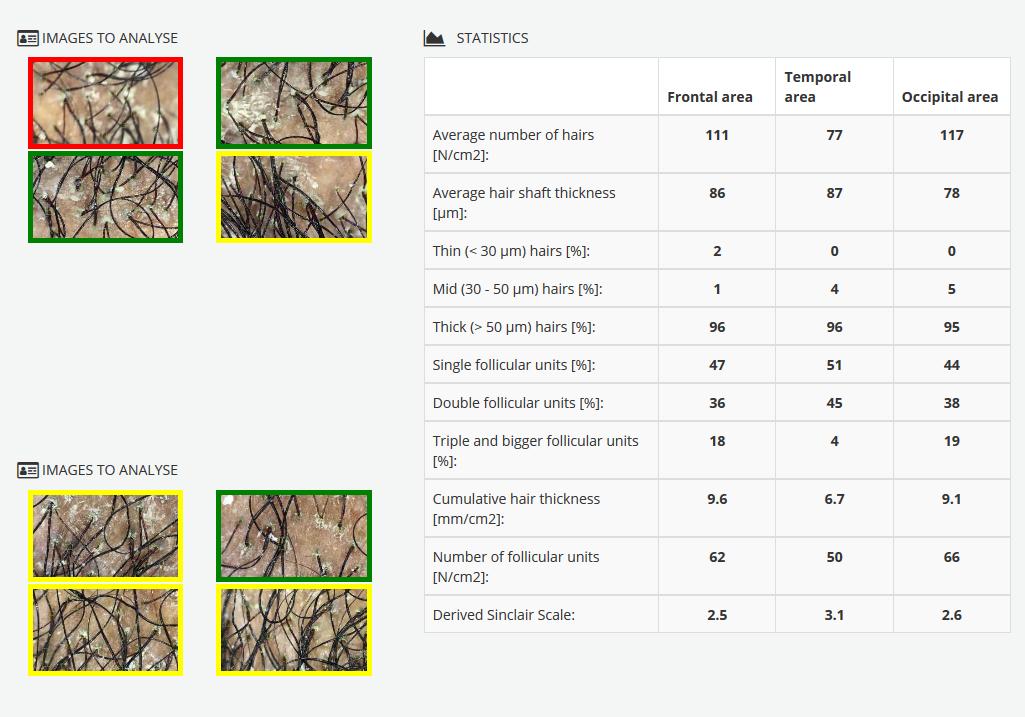
It looks at:
- Average number of hairs
- Hair shaft thickness
- Hair distribution
- Empty follicles
- Cumulative Hair Thickness
- Number of follicular units
Which conditions could it help to diagnose?
The conditions that it helps to diagnose include:
- Acne keloidalis nuchae
- Alopecia areata
- Alopecia areata incognito
- Alopecia senilis
- Anagen effluvium
- Androgenetic alopecia
- Aplasia cutis congenita
- Central centrifugal cicatricial alopecia
- Congenital triangular alopecia
- Discoid lupus erythematosus
- Dissecting cellulitis
- Folliculitis decalvans
- Frontal fibrosing alopecia
- Lichen planopilaris
- Loose anagen syndrome
- Monilethrix
- Pediculosis
- Pseudomonilethrix
- Pseudopelade de Brocq
- Scalp psoriasis
- Seborrheic dermatitis
- Syphilitic alopecia
- Telogen effluvium
- Tinea capitis
- Traction alopecia
- Trichotillomania
The test is used by doctors including hair transplant surgeons worldwide.
For more information about the test, and to view the privacy policy, please visit www.tricholab.com
Why the Handyscope is used
Trichoscopy is the “gold standard” for non-invasive hair analysis. By using the Handyscope, we can capture high-resolution images of your scalp in real-time. This allows us to examine your hair at 20x magnification with precision autofocus, ensuring we never miss the subtle details that the naked eye might overlook.
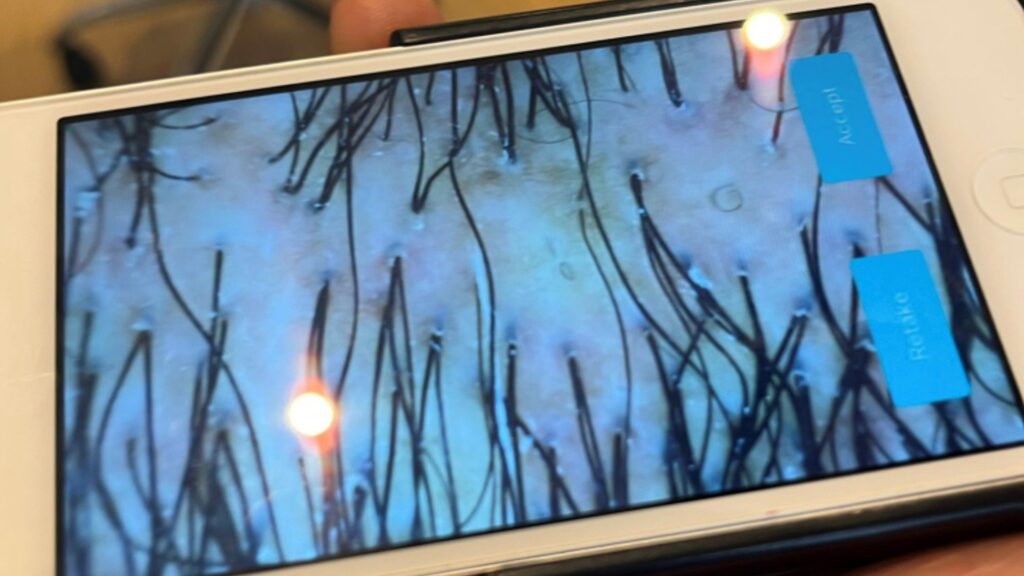
You may have seen larger, more stationary imaging rigs in clinical settings. We have opted for the Handyscope because it delivers comparable image quality to more expensive, bulky kits without sacrificing diagnostic depth.
| Feature | Handyscope Benefits |
| Resolution | High-definition imaging for crystal-clear follicle visualization. |
| Analysis | Specialized software evaluates hair density and scalp health. |
| Comfort | A portable, non-invasive experience that can be performed anywhere in the clinic. |
| Consistency | Precision optics ensure reliable tracking of your progress over time. |
Is TrichoLab imaging included in follow up consultations?
To keep the focus on clinical review, imaging is not included in the 1st and 2nd follow-up appointments as part of the consultation package. The full process is outlined on the following page: Trichology Consultation for hair loss – Crewe Hair and Skin Clinic 01270 747 393
If you would like an extra TrichoLab report, there is a separate fee which includes a follow-up call to discuss the results in detail.
For a full list of services and current rates, please visit the following webpage Price List – Crewe Hair and Skin Clinic 01270 747 393. To view a booklet explaining the services provided for hair restoration please click here.