What are warts?
Warts are small, rough, viral growths on the skin. They are very common and are usually spread by direct skin-to-skin contact or indirectly through shared contact with contaminated surfaces (e.g. swimming pool changing room floors). They spread virally and can be unsightly, with a cauliflower like appearance.
They are typically found under the feet, on the hands and fingers, can be spread by shaving or appear at sites of trauma/injury. Warts are contagious but the risk of transmission is low.
They can be treated by paring down, laser therapy, duct tape or solutions containing salicylic acid which can be prescribed by your GP or purchased over the counter.
The appearance of warts peaks in the teenage years and subsides thereafter. Studies have shown that between 5% and 30% of children and young adults have warts. Warts in younger children will appear and disappear within 1-2 year; however warts in adults may persist for up to 10 years.
At this clinic if there is any doubt about the nature of the skin lesion you will be asked to see your GP. If you have already seen your GP and confirmed the diagnosis with them, then you should be able to see confirmation of this on your medical record which should be summarised on your NHS App.
How the clinic can help
Only adults over the age of 18 can be treated at the clinic. The face and intimate areas are not treated. A remote consultation is required first before you consent to the procedure at the clinic. Your are requested to email photos of the area you would like treating to info@crewehairandskinclinic.uk before the meeting.
Freezing (cryotherapy) is the preferred method of reduction at this clinic, but it may not be suitable for all warts. Electrolysis can be offered as an alternative.
Warts can be stubborn, often taking multiple treatments. Where necessary there must be a 4-6 week period between treatments where necessary.
This is not a sensation free treatment and some discomfort will be experienced. Pain threshold vary from client to client and area to area. Local anaesthetic cream can be applied 20 minutes before the treatment.
Important to know
The treatment does not get rid of the virus that causes warts, so the wart may return.
This treatment should be considered to be wart reduction rather than removal. It may not be possible to entirely remove the wart at the first appointment. It is important to be aware that multiple treatments may be needed. It is impossible to predict who this will apply to unfortunately.
Freezing treatment (cryotherapy) for warts
Freezing treatment - Hydrozid
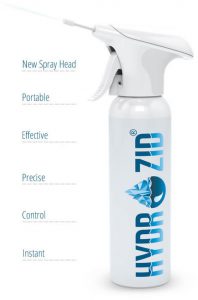
This clinic uses Hydrozid, which is a combination of traditional cryotherapy and cryosurgery with modern aerosol technology.
It contains the same propellant used in several asthma inhalers (norflurane).
The design of the spray head and tube’s material makes it easier to target the tissue to be treated so mitigating the risk of damaging the surrounding healthy skin. The tip has a conical inner shape that also prevents condensation and dripping during treatment.
Video of part of a freezing treatment for a wart on the knee
There are multiple cycles of freezing and thawing
Diathermy (electrolysis) treatment for wart removal

Electrolysis can help with the appearance of warts, but they can be stubborn, often taking multiple treatments to remove. The procedure involves applying a current with a fine needle. Treatments are usually done in 20-minute sessions.
How many treatments are needed?
The following factors will have an impact on the number of treatments required: what type of wart is being treated and its location, skin sensitivity, the condition of the skin and how well the skin heals. Pain thresholds will vary from person to person.
How long should be left between electrolysis/diathermy treatments for wart reduction?
A 4-to-6-week period between treatments is usually necessary.
Who is electrolysis/diathermy not suitable for?
The following are reasons which will prevent diathermy treatments
- Cochlear implants (written evidence from manufacturer)
- Haemophilia
- Keloid scarring
- Pacemakers (written evidence from manufacturer)
- Under 18s are not treated at this clinic unless over the age of 16 with written parental consent
The following are potential contra-indications which restrict diathermy treatments (some will not apply to verrucae):
- AIDS/HIV
- Asthma
- Bacterial infections
- Blood thinning medication (e.g. warfarin or aspirin)
- Cancer
- Circulatory disorders
- Dermabrasion (wait a minimum of 1 month)
- Dermographic skin conditions
- Diabetes
- Dysmorphia (Body dysmorphic disorder or BDD)
- Emphysema
- Epilepsy
- Fitzpatrick skin types IV, V, VI
- Heart conditions/circulatory disorders
- Hepatitis
- High blood pressure
- Laser treatment (wait a minimum of 2 weeks)
- Nervous client
- Phlebitis/thrombosis (if in area to be treated)
- Recent scar tissue (if in area to be treated)
- Rosacea (if in area to be treated)
- Skin diseases and disorders
- Sunburned skin (if in area to be treated)
- Swelling/oedema
What should be done after treatment?
After treatment please
- Do not touch the treated area, and do not remove any scabs that may appear.
- Apply after-care product regularly with clean fresh cotton wool until the area has completely healed.
- After-care products recommended for use are Sterex which hazel gel for 24 to 48 hours, followed by 28 days of Sterex aloe vera gel. You will be supplied with these at the first appointment. This is applied twice a day and offers additional antibacterial properties.
- No swimming, sauna, steam rooms, exfoliation or scrubs, waxing or other beauty treatments until the area has completely healed.
- Please avoid UV exposure during the healing process. The area treated should be protected by sunscreen at all times particularly in the summer months.
- Avoid using any possible skin sensitisers or irritant such as perfumes, fake tan products or perfumed body lotion
What are the main risks of electrolysis/diathermy for wart reduction?
- Pitting. This is a form of scarring that causes the skin to drop below the surface of the surrounding skin. It may improve with time depending on the severity of the damage but can be permanent.
- Scabbing. Scabs should not be picked off or a pit may result, taking several months to heal. If the scab is left to fall off the skin will appear pink but will revert to normal in time.
- Bruising. This will usually heal leaving no permanent damage
- Bleeding.
- Pigmentation changes. These can sometimes occur naturally and are not connected to the treatment. This can either be darkening skin colour or loss of skin colour
- Scarring. The chances of this will be reduced with following after-care instructions strictly
- Pustules/infection.
- Redness
- Swelling